Introduction
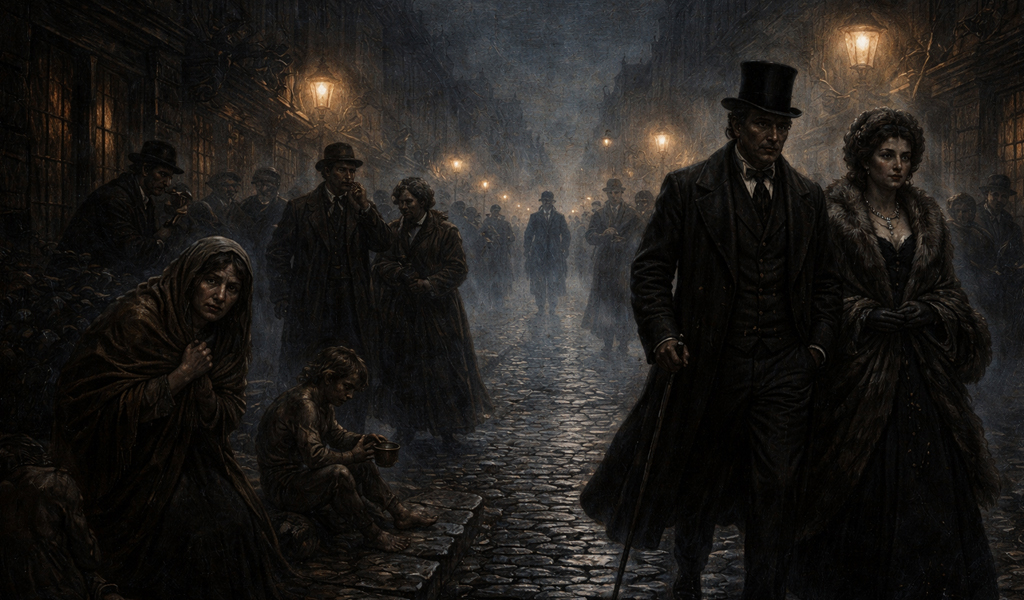
The fascination with the occult in the Victorian era is often overshadowed by the period’s reputation for rigid morality, technological innovation and rapid urbanization. Yet beneath that disciplined surface lay a far more unsettling world, driven by a deep need to understand what could not be seen.
While progress promised rational explanations, millions of people turned their attention to invisible realms: spirits, ancient symbols, rituals to contact the afterlife, hermetic societies and philosophies that blended science with superstition. The fascination with the occult in the Victorian era was not a marginal curiosity or an eccentric trend, but a powerful social phenomenon rooted in everyday life.
This obsession permeated aristocratic salons, private clubs, literary circles and improvised laboratories alike. The same era that invented the railway, photography and the telegraph also embraced—without embarrassment—the exploration of the supernatural, convinced that unseen forces still governed human existence.
Spiritualism as an emotional refuge in the fascination with the occult in the Victorian era
Conversations with the afterlife
During the height of the Industrial Revolution, countless families endured sudden deaths, incurable diseases and disappearances in overcrowded cities. In this context, spiritualism became a cornerstone of the fascination with the occult in the Victorian era.
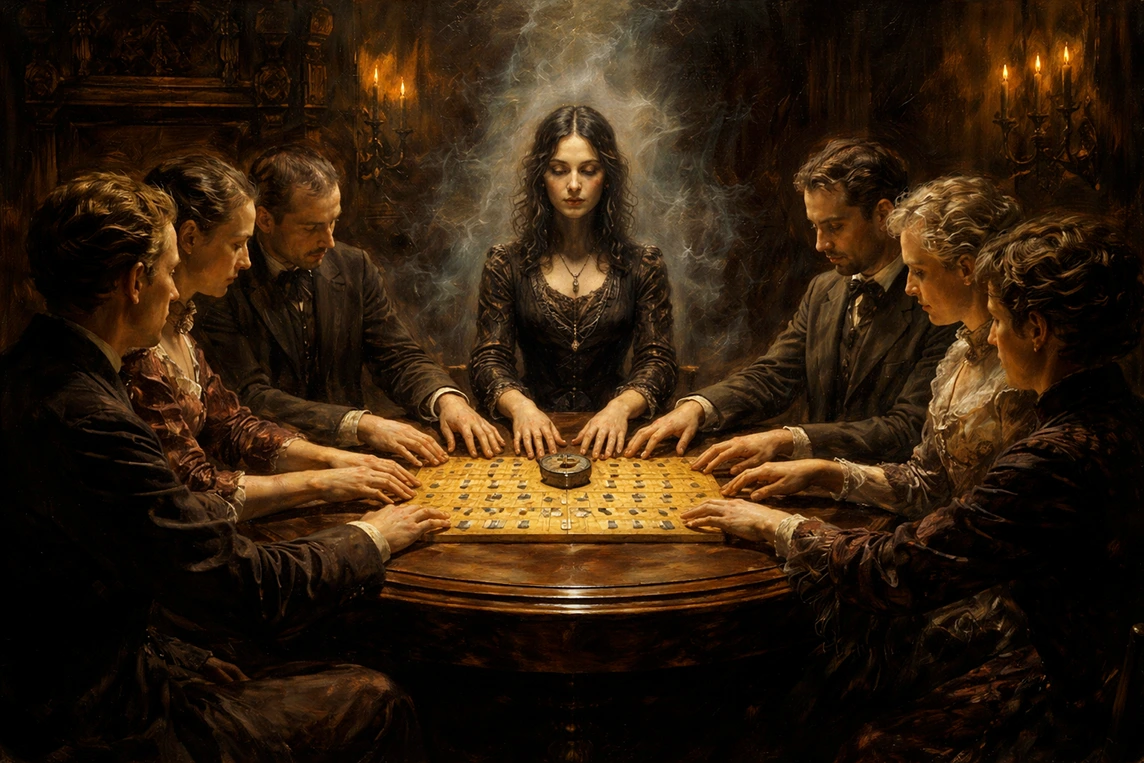
Spiritualism offered something neither medicine nor organized religion could guarantee: the possibility of hearing the voice of a deceased loved one again. Spiritualist séances commonly included practices such as:
-
Knocks that answered spoken questions.
-
Automatic writing attributed to spirits.
-
Tables that turned or lifted without visible cause.
-
Mediums entering deep trances.
Far from being limited to elites, spiritualism crossed social classes and became embedded in Victorian daily life.
The blend of science and hope
Many scientists, physicians and engineers attended séances in an attempt to prove their authenticity. Their aim was not magic, but laws, patterns and measurable effects. This mindset explains why the fascination with the occult in the Victorian era was so closely linked to emerging scientific thought.
The period was filled with hybrid investigations in which telescopes stood beside candles, laboratory notebooks alongside prayers, and mathematical calculations next to ritual invocations. This coexistence was not seen as contradictory, but as a natural extension of humanity’s desire for knowledge.
Secret societies and forbidden knowledge
The rise of esoteric circles
Curiosity about the hidden world gave rise to organizations promising access to ancient wisdom and concealed truths. Within the fascination with the occult in the Victorian era, these societies offered structure, belonging and a shared symbolic language.
Among the most influential were:
-
The Hermetic Order of the Golden Dawn.
-
The Theosophical Society.
-
Late Rosicrucian circles.
-
Lodges devoted to Kabbalah, alchemy or ritual magic.
These groups claimed to safeguard knowledge transmitted from Egypt, Persia or Greece, wrapped in symbolic rituals that promised the awakening of inner abilities.
Symbols, initiations and hierarchies
Members studied magical alphabets, occult correspondences, rituals involving perfumes, colors and metals, and complex initiation systems. At this point, the fascination with the occult in the Victorian era moved beyond simple superstition to become a form of intellectual self-exploration and mental discipline.
Magnetism, energy and liminal or hybrid science
Investigating the invisible
The theories of Mesmer and his followers popularized the idea that an invisible force—“animal magnetism”—flowed through the human body. Although later refuted, this concept played a decisive role in the fascination with the occult in the Victorian era.
It inspired new ideas about energy currents, hypnosis, trance states, spiritual sensitivity and altered states of consciousness. Victorians did not draw clear boundaries between science and pseudoscience; instead, both realms overlapped and reinforced one another.
Hypnosis and the search for the subconscious
Early hypnotic sessions fascinated both physicians and the general public. It was believed that trance states could:
-
Open hidden doors of the mind.
-
Reveal repressed memories.
-
Enable spiritual communication.
-
Unlock psychic abilities.
These beliefs anticipated ideas that would later influence depth psychology and the study of the subconscious.
Literature, art and the supernatural
Horror as a cultural reflection
Victorian literature transformed the occult into a powerful aesthetic language. Writers explored apparitions, family curses, haunted houses, invisible pacts and symbolic creatures. In this context, the fascination with the occult in the Victorian era served as a metaphor for the conflict between reason and desire.
Illustration and symbolism
Illustrators and artists produced works filled with arcane symbols, sinuous lines and unsettling atmospheres. The public consumed these images as visual fragments of a forbidden world, further reinforcing the presence of the occult in popular culture.
Obsession with omens and mysticism
Amulets and urban superstitions
Modern life caused many rural superstitions to adapt to urban environments. Within the fascination with the occult in the Victorian era, it was common to find talismans against misfortune, protective objects in homes and businesses, and rituals intended to attract luck or avert disaster.
Astrology and personal destiny
Astrology reappeared in newspapers, social gatherings and private consultations. In an age of rapid change, many people sought in the stars the stability that industrial society failed to provide.
Why did the occult captivate an entire era?
The gap between faith and science
Traditional religion no longer answered all fears, and science had not yet reached humanity’s deepest questions. The fascination with the occult in the Victorian era filled this gap, promising that mysteries could still be explained—or at least experienced.
Uncertainty as nourishment
Rapid social transformation—railways, electricity, factories and mass migration—generated collective anxiety. The supernatural offered an alternative narrative to the harsh realities of constant change.
“The occult was not an escape from reality, but the hope that something existed beyond it.”
— London cultural chronicle, 1897
Conclusion
The fascination with the occult in the Victorian era was a profound expression of the contradictions of its time. Roaring machines in factories coexisted with drawing rooms where lights were dimmed in hopes of speaking with spirits.
Far from being a marginal obsession, the occult represented a collective attempt to find meaning in a world changing too quickly. Today, this fascination remains alive in literature, art and popular culture, reminding us that even in moments of greatest progress, humanity continues to seek answers in the shadows.