Introduction
Understanding how a crime was solved in the 19th century requires stepping into a world where certainty was rare and evidence was fragile. Rapid urban growth, understaffed police forces, and the absence of standardized forensic techniques made criminal investigation an almost impossible task. Cities expanded faster than law enforcement structures, and most cases relied more on human judgment than on scientific proof.
Yet from this uncertainty emerged a silent transformation. Investigators, physicians, and early criminologists began to convert criminal investigation into a methodical discipline. Following an invisible trail—habits, motives, traces, routines, and barely perceptible material evidence—became central to how a crime was solved in the 19th century, laying the groundwork for modern criminology.
The Crime Scene Before Science
Chaos, Onlookers, and Contamination
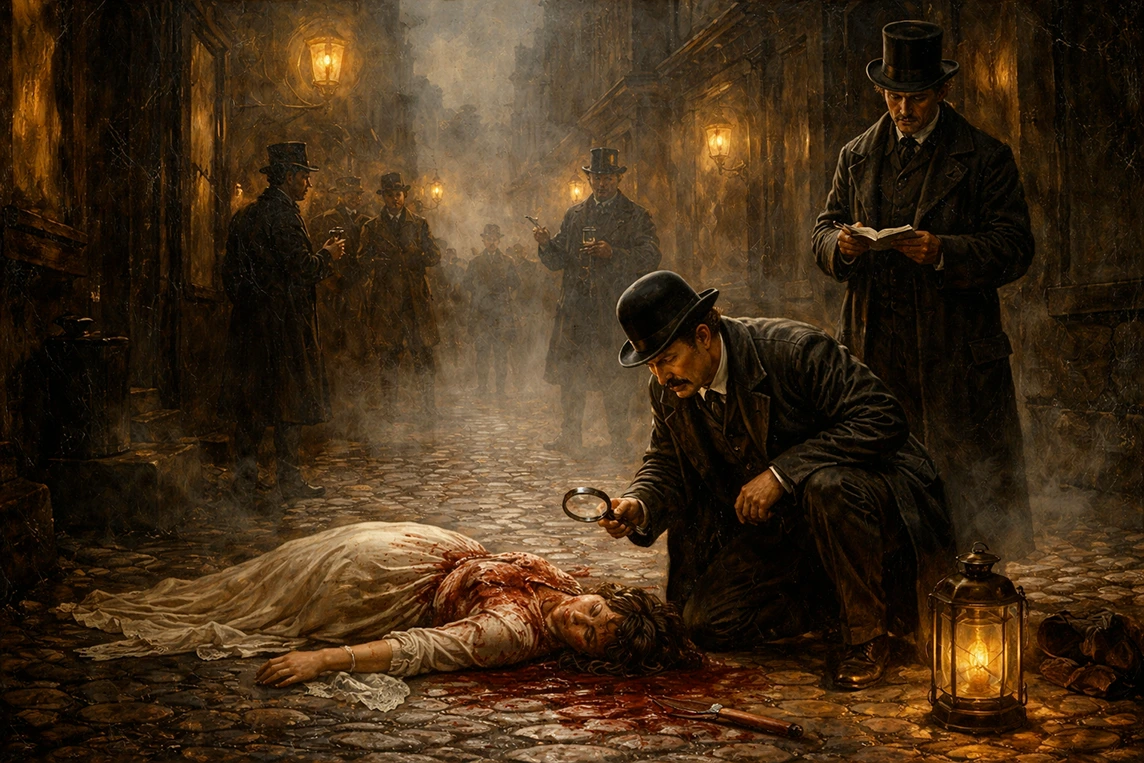
In the early 19th century, crime scenes were not preserved. Neighbors, police officers, journalists, and relatives freely walked around the body. To understand how a crime was solved in the 19th century, one must accept that the priority was restoring public order, not preserving evidence. Contamination was inevitable and largely unquestioned.
Intuition as the Primary Tool
Without laboratories or protocols, investigators relied on social observation. How a crime was solved in the 19th century depended heavily on:
• Contradictions in witness statements
• Public reputation of suspects
• Known financial or emotional motives
• Neighborhood rumors and social ties
Crime was treated as a social puzzle rather than a scientific problem.
The Birth of Method: Doctors and Alienists
The Rise of Forensic Medicine
Advances in anatomy and physiology allowed physicians to examine bodies with increasing rigor. Autopsies, wound analysis, and early toxicology provided objective data. This marked a turning point in how a crime was solved in the 19th century, as scientific observation began to support investigative reasoning.
Alienists and the Criminal Mind
Early psychiatrists, known as alienists, focused on the behavior and mental state of criminals. Though primitive by modern standards, they introduced a revolutionary idea: the trace of a crime is not always physical. Understanding how a crime was solved in the 19th century means recognizing the first attempts to analyze criminal psychology.
Tracking Habits and Patterns
The Observational Method
During the Victorian era, many crimes were solved by identifying recurring patterns:
• Repeated schedules
• Familiar routes
• Preferred objects
• Rituals or personal obsessions
This approach illustrates how a crime was solved in the 19th century through an early form of criminal profiling.
The Importance of the Urban Environment
Nineteenth-century cities were dense and labyrinthine. Narrow streets, factories, and taverns allowed criminals to vanish easily. Therefore, understanding how a crime was solved in the 19th century required analyzing:
• Neighborhood routines
• Street lighting
• Secondary alleys
• Economic activity by district
• Potential witnesses
The city itself became part of the evidence.
Early Material Evidence
Objects, Fibers, and Tools
Without DNA or advanced microscopy, investigators depended on forgotten objects. A handkerchief, torn garment, or distinctive weapon could become the centerpiece of a case. This reliance on tangible clues defines how a crime was solved in the 19th century.
Blood and Biological Traces
While individual identification through blood was impossible, investigators could distinguish human from animal blood and detect poisons. These developments represented a major step in how a crime was solved in the 19th century using emerging science.
Testimony and Contradiction: The Detective’s Weapon
Listening to Discover
Without audio recordings, oral testimony was critical. Investigators analyzed pauses, contradictions, body language, and inconsistencies in timelines. This psychological scrutiny was essential to how a crime was solved in the 19th century.
The Power of the Alibi
Verifying an alibi meant physically retracing movements across the city and interviewing dozens of people. Solving a crime was essentially mapping daily life, a defining element of how a crime was solved in the 19th century.
Footprints, Footwear, and Physical Traces
Footprints in the Mud
Before fingerprinting, shoe prints and wheel tracks were crucial. Rain, mud, and damp pavements often preserved these traces, unexpectedly aiding how a crime was solved in the 19th century.
Footwear as Identity
Cobblers could identify their own work through stitching, nails, or wear patterns. Minor details could expose a suspect, reinforcing the artisanal nature of how a crime was solved in the 19th century.
The Limitations of the 19th Century
The Anonymous Killer
Without national records, criminals could relocate and start anew. Many cases remained unresolved, a structural limitation of how a crime was solved in the 19th century.
The Influence of the Press
Sensationalist newspapers pressured police and distorted testimony. Crime became public spectacle, complicating investigations and shaping how a crime was solved in the 19th century.
The Legacy of the 19th Century in Modern Investigation
What Endures
Many modern principles originate here:
• Crime scene preservation
• Pattern recognition
• Environmental analysis
• Motive examination
• Identity recording
• Science as investigative guidance
What Evolved
Rudimentary techniques gave way to DNA analysis, biometric databases, luminol, 3D reconstructions, and artificial intelligence. Yet the essence of how a crime was solved in the 19th century remains unchanged: seeing what others overlook.
“Crime leaves traces even when it seems to leave none.”
— London Police Manual, 1894
Conclusion
Solving a crime in the 19th century meant following an almost invisible trail—fragments of daily life, human contradictions, habitual behavior, environmental clues, and subtle physical traces. Understanding how a crime was solved in the 19th century reveals the origins of modern forensic investigation. Contemporary science stands on these foundations, proving that truth is often reconstructed from signals that appear, at first glance, not to exist at all.