Introduction
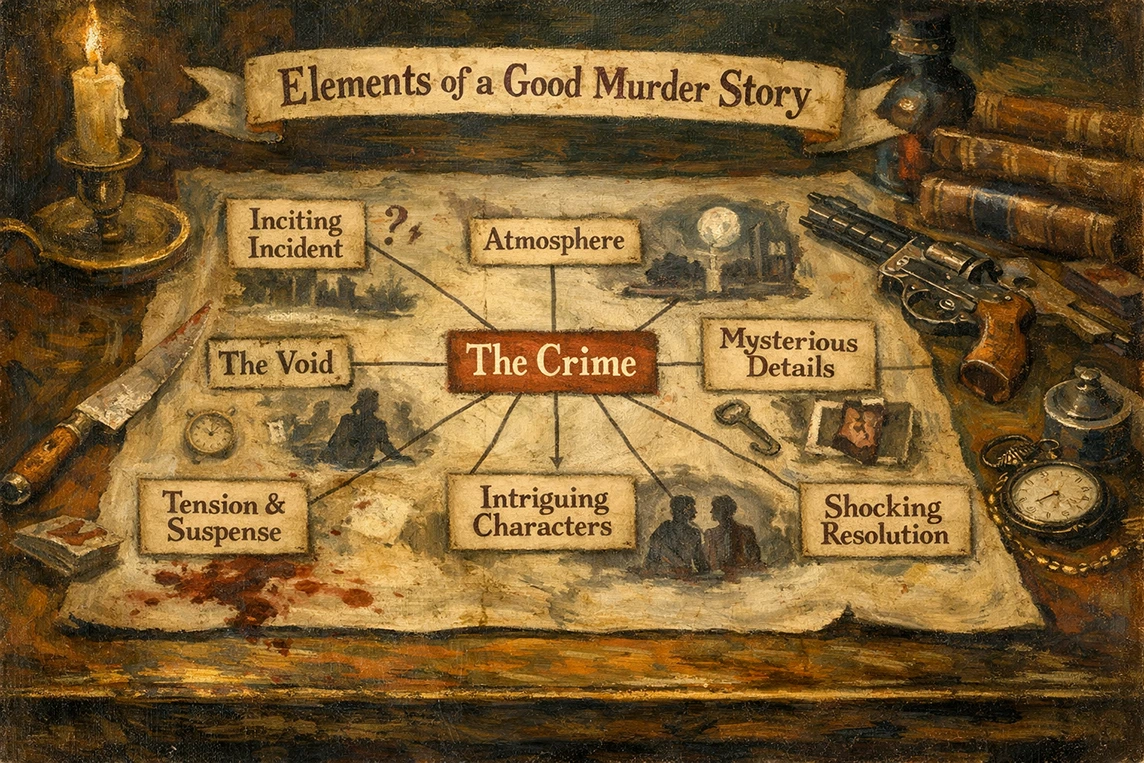
The elements of a good murder story are not based on explicit violence or graphic bloodshed, but on the narrative engineering that supports every decision within the text. An effective murder story is built with precision: every detail, every pause, and every silence serves a clear structural purpose.
Great crime narratives—from classic short stories to contemporary thrillers—work because of a careful balance between tension, information, and narrative absence. Understanding the elements of a good murder story is essential to grasp why the murder itself is never the true center of the story, but rather the trigger for a complex psychological experience that grips the reader from the very first line.
1. An Inciting Incident That Breaks the World
Any serious examination of the elements of a good murder story begins with the inciting incident. This is the event that fractures the existing order and disrupts apparent normality.
It does not need to be spectacular. It can take the form of:
-
An unexplained disappearance
-
An object found where it should not be
-
A contradictory testimony
-
An unexpected silence
What matters is that this moment forces the reader to ask an immediate question: what happened here?
2. The Void Left by the Crime
Among the elements of a good murder story, the void created by the crime is more important than the violent act itself. Murder generates an emotional, social, or symbolic absence that propels the entire narrative forward.
The story advances because something is missing, and that absence demands to be understood, sustaining tension throughout the text.
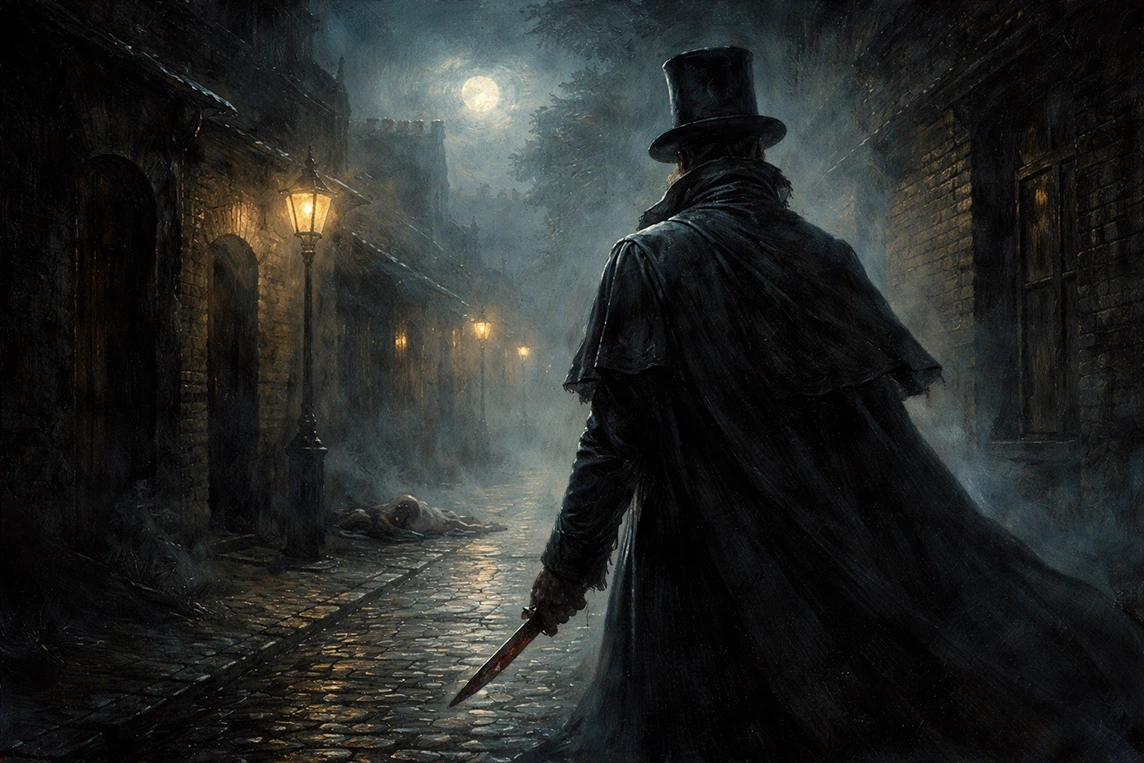
3. An Atmosphere That Breathes Tension
Atmosphere is one of the most decisive elements of a good murder story. Setting is not decoration; it is a narrative code that communicates meaning.
A strong story uses space to suggest:
-
A house that is too quiet
-
A street lit only halfway
-
An elegant building hiding secrets
-
A town where everyone knows something
Atmosphere does not explain—it implies.
4. The Sensory Rhythm of the Narrative
Within the elements of a good murder story, sensory rhythm allows the reader to feel without being told what to feel. Sound, light, smell, and temperature operate as narrative layers that reinforce unease.
A well-constructed sensory atmosphere turns any ordinary detail into a potential clue or threat.
5. Conscious Control of Information
One of the most technical elements of a good murder story is information management. A strong crime narrative does not deliver facts—it distributes them.
There must be a constant balance between:
-
What is said
-
What is shown
-
What is withheld
Each revelation should generate new questions, maintaining the sense that discovery is always imminent.
6. The Pause as a Narrative Tool
Not every moment should be intense. The pause is a crucial component among the elements of a good murder story, allowing tension to breathe and accumulate.
Trivial conversations, brief descriptions, or seemingly neutral memories reinforce contrast and prevent predictability.
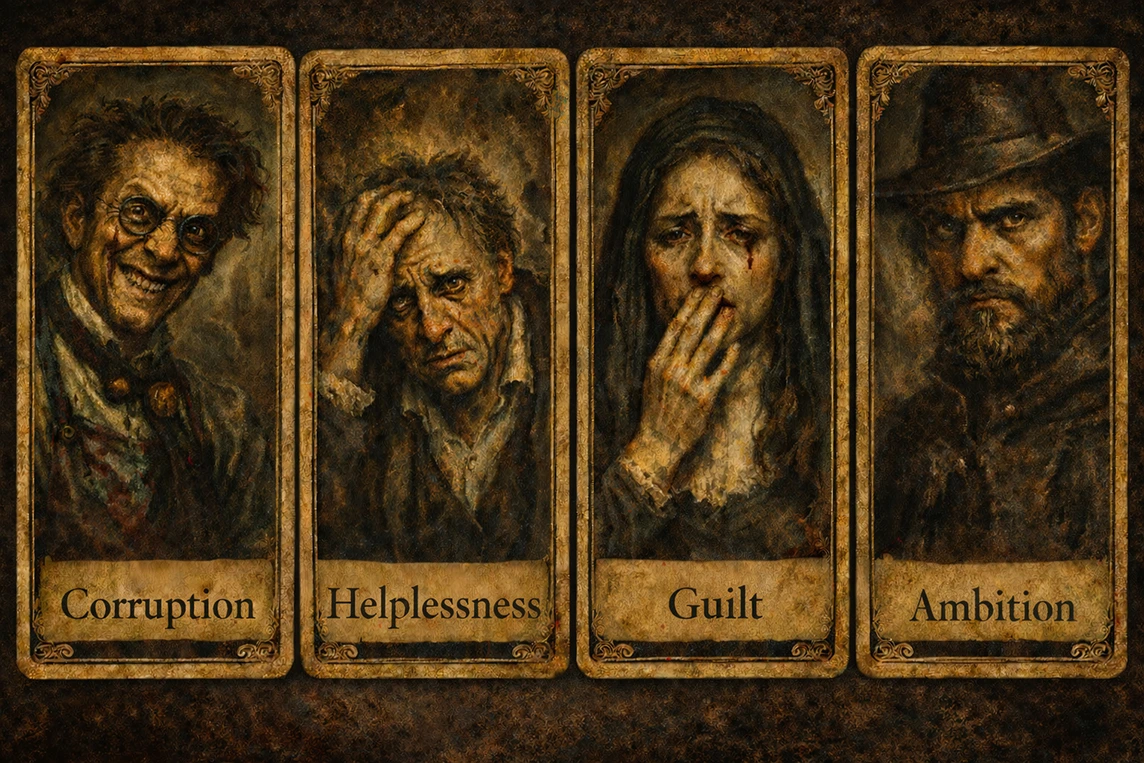
7. Characters as Forces in Conflict
In the elements of a good murder story, characters function not as static profiles but as narrative forces in constant collision:
-
The one who wants to reveal the truth
-
The one who needs to hide it
-
The one who fears discovering it
-
The one who prefers not to look
The friction between these forces generates inevitable consequences that drive the plot forward.
8. The Significant Detail
In crime fiction, details rule. One of the defining elements of a good murder story is the ability to assign narrative weight to what initially appears insignificant.
A gesture, a mark, a misplaced object, or a phrase spoken too quickly can support the entire story. The detail seems irrelevant—until it is not.
9. The Resolution and Its Echo
The final of the elements of a good murder story is the resolution, which determines the lasting impact of the narrative. A murder story may conclude in different ways:
-
Deductive closure: everything fits together with clarity
-
Surprising closure: the reader realizes the evidence was misread
-
Unsettling closure: the truth is revealed, but offers no comfort
A strong story leaves an echo that persists beyond the final paragraph.
“It is not the crime that captivates, but the way it forces us to look at what we would rather ignore.”
— Anonymous essay, 19th century
Conclusion
The elements of a good murder story are not defined by the crime itself, but by the emotional and intellectual journey the narrative proposes. It is a precise balance between light and shadow, between what is visible and what is hidden, between words and silence.
When these nine elements work in harmony, the murder ceases to be a mere plot device and becomes a coherent, unsettling, and enduring literary experience.