Introduction
Opus Mortis was not born as a business project, nor as an idea designed to fit a trend.
It began as an uncomfortable question that refused to go away.
About ten years ago, after discovering crowdfunding platforms and seeing many people trying to bring their own board games to life, an inevitable thought emerged:
if we were ever to create a game, what would it need to make people want to play it again and again, for years, without growing tired of it?
That question became the true origin of Opus Mortis.
The Need to Do Something Different
From the very beginning, it was clear we didn’t want to create just another investigation game. Many titles in the genre focus on solving a puzzle, identifying the culprit, and moving on to the next case. That structure works, but it often avoids the most uncomfortable part of crime.
The mind of the killer.
The moral weight of decisions.
The real consequences of being wrong.
Opus Mortis began to take shape when we realised we wanted to look precisely where most games look away. Not through explicit content, but through psychological and moral tension.
An Idea That Grew Over Time
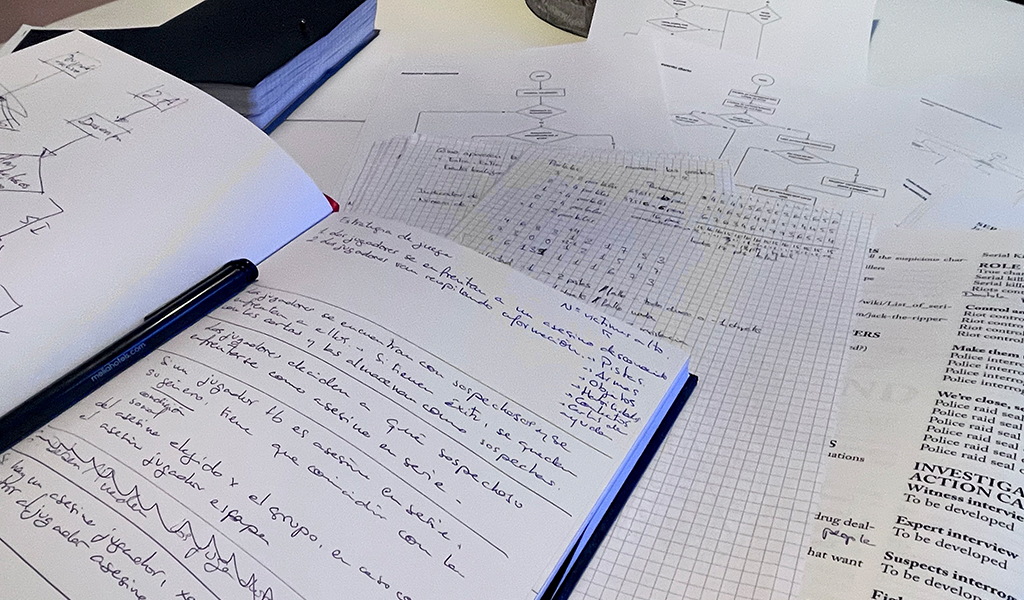
The development of Opus Mortis was never linear. For years, progress came in fragments: during holidays, weekends, and spare moments. The idea was left to rest, revisited, expanded, and revised time and again.
That time was not a setback, but an advantage. It allowed us to discard ideas that worked on paper but didn’t fit the tone we were searching for. It also made one thing very clear: the game needed to be adult—not in a graphic sense, but in a morally uncomfortable one.
We didn’t want a fully cooperative game where all players move forward without friction. We wanted a system where you can’t always trust the person sitting next to you, where selfish decisions are part of the design, and where mistakes carry real consequences within the game.
Clear Influences, but a Different Approach
The fascination with figures such as Jack the Ripper, along with crime and investigation literature and cinema, was an obvious influence. Not because we wanted to recreate real events, but because these stories force the audience to confront uncomfortable questions:
What drives someone to cross certain lines?
What is the cost of knowing the truth?
What happens when social order begins to fracture?
The Victorian era emerged almost naturally as the setting. It was a time of technological and scientific progress, but also of inequality, overcrowding, and fear. A perfect context to explore the birth of the modern serial killer and the earliest methods of criminal investigation.
The Project We Didn’t Want to leave behind
Over time, Opus Mortis stopped being just an interesting idea and became something difficult to let go of.
Not out of pride, but because each iteration improved on the last and made it clear there was still room to go deeper.
The goal was never to create a fast or lightweight game. We wanted playing Opus Mortis to feel like gathering without watching the clock—like a good role-playing session where the experience matters more than the time spent.
Today, after many years of quiet development, Opus Mortis continues to move forward guided by the same core idea: not to create a game that is forgotten once the session ends, but an experience that leaves a lasting mark.