The Power of the Occult in the Victorian Era and Its Reflection in Opus Mortis
Introduction
By the end of the 19th century, London’s fog did more than conceal its streets: it also hid the beliefs, fears, and obsessions of a society facing a profound spiritual crisis. This historical and emotional context is essential to understanding Victorian occultism Opus Mortis, a central thematic axis linking fascination with the unseen to the game’s narrative depth.
The Victorian era became the meeting point between emerging science and mysteries that refused to disappear. This constant tension between reason and superstition fueled a culture obsessed with the occult, the forbidden, and the inexplicable. That same fascination with the invisible is one of the main sources of inspiration behind Opus Mortis, a narrative board game where the boundary between logic and superstition dissolves among cards, secrets, and morally ambiguous choices.
“During the development of Opus Mortis, we realized that the oldest fear is not darkness itself, but what we believe we see within it.”
— Opus Mortis Creative Team
The Spiritualist Fever of the 19th Century
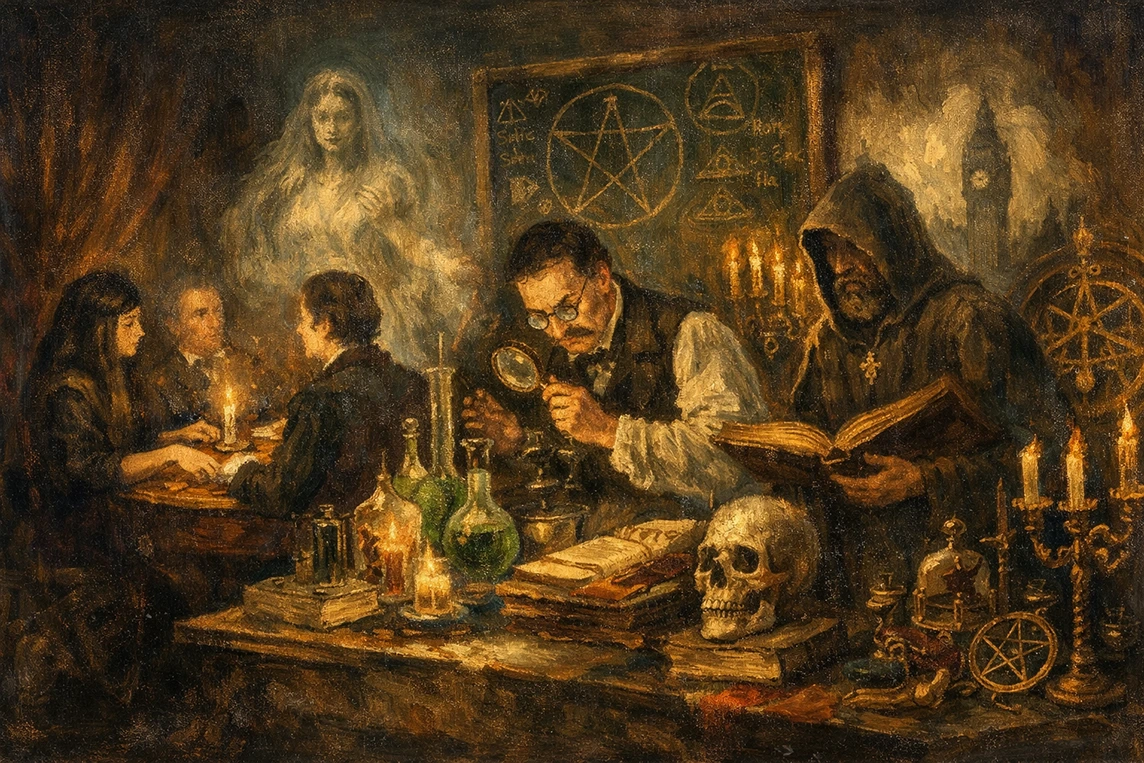
The second half of the 19th century witnessed an unprecedented rise of the supernatural. While industrial progress reshaped the world, thousands sought comfort in spirit boards, mediums, and séances. This cultural phenomenon crossed social classes and laid the foundations of what we now define as Victorian occultism.
In upper-class parlors, people spoke with the dead, analyzed shadows, and photographed supposed apparitions. Victorian occultism was not a fleeting trend, but a cultural reaction to the vertigo of modernity. Faced with unstoppable scientific progress, humanity needed to believe that something still existed beyond its control.
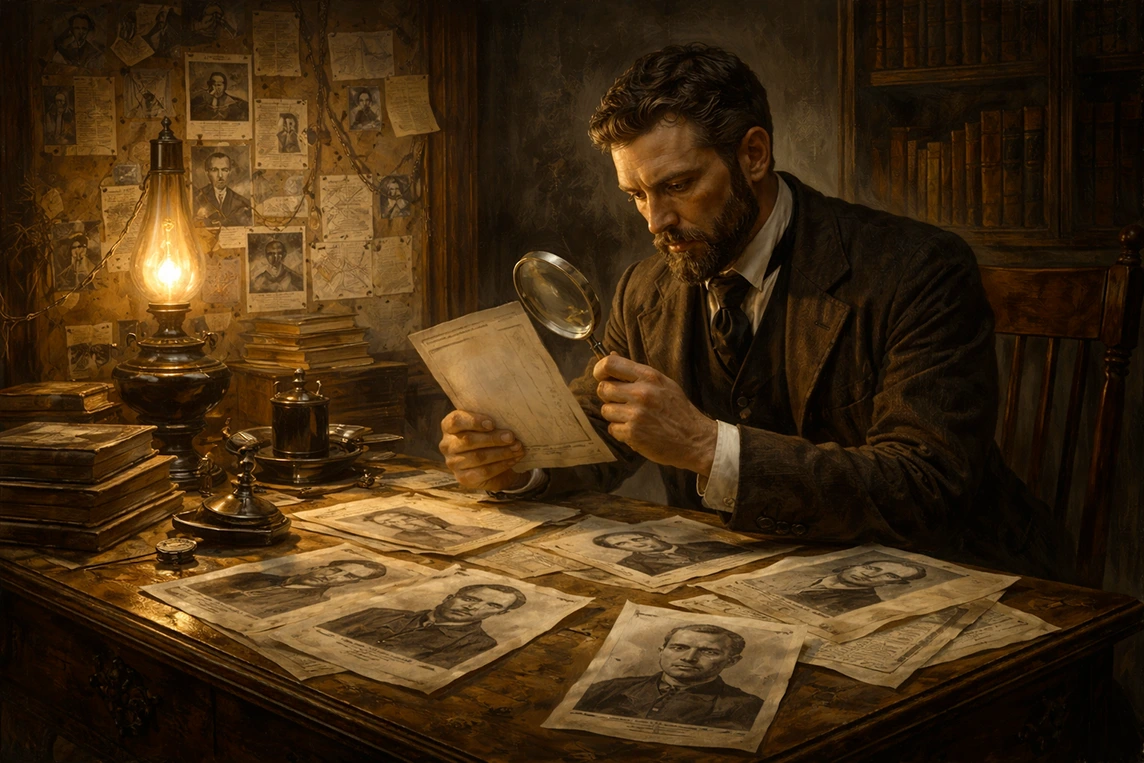
This duality—the investigator versus the believer—is also the soul of Victorian occultism Opus Mortis: each player must choose between empirical evidence and irrational fear, between uncovering the truth or recoiling from it.
Secret Societies and the Art of the Forbidden
In the shadows of major institutions, discreet circles devoted to hermeticism, alchemy, and theosophy flourished. These organizations embodied the desire to access hidden knowledge reserved for a select few.
Societies such as the Golden Dawn or the Rosicrucians blended religion, symbolism, and pseudoscience in their search for meaning. To their contemporaries, these members were not heretics, but explorers of the human soul.
The universe of Opus Mortis draws directly from this imagery. Occult symbols engraved on cards, rituals hinted at in scenarios, and whispers in the darkness are not mere decoration, but narrative devices that convey the pursuit of meaning beyond reason.
“The true horror is not in ghosts, but in those who try to speak with them.”
Science and Superstition: A Shared Language
The 19th century also marked the birth of psychology, criminology, and forensic photography. Yet the boundaries between science and esotericism were blurred. Doctors studied phrenology, alienists believed in animal magnetism, and photographers claimed to capture souls on film.
Victorian occultism Opus Mortis reinterprets this tension within its game mechanics. The alienist may analyze the killer’s mind, only to fall victim to personal obsessions, while the medium accesses truths that reason refuses to accept.
Both paths lead to the same destination: knowledge… or madness.
Occult Symbolism in Victorian Art
Artists such as John William Waterhouse and Gustave Doré filled their works with allegories, myths, and shadows. In Victorian art, beauty and death merged into a single stroke, just as in Opus Mortis aesthetics do not embellish, but corrupt.
The game’s artists drew from these contrasts: gaslight as a symbol of fragile faith, mirrors as conscience, and blood as revealed truth. MAE MIA, MAE MIA. Every visual element—cards, boards, portraits—was designed according to a clear narrative principle: nothing is accidental; everything carries meaning.
A pentagram in a corner, a twisted gesture, a withered flower—each detail may serve as a clue or a warning within the world of Victorian occultism Opus Mortis.
The Morality of Mystery
Victorian occultism also served as a moral refuge. In a rigid and deeply religious society, interest in the afterlife allowed people to explore forbidden subjects: the soul, sin, guilt, and death.
From this emerges the ethical core of Opus Mortis, where each session poses an uncomfortable question: how far are you willing to go to uncover the truth? The player does not merely investigate a crime; they investigate the corruption of their own morality.
The boundary between investigator and murderer becomes blurred, echoing occult thought itself: truth always has two faces.
Echoes of the Occult in the Universe of Opus Mortis
The narrative team behind Opus Mortis did not portray occultism as spectacle, but as cultural atmosphere. The unnamed city where the story unfolds is filled with signs: abandoned temples, discreet societies, pamphlets promising salvation, and shadows that seem to whisper.
Everything invites the player to doubt their senses.
“During the game’s design, we understood that Victorian occultism was not a trend, but an emotional necessity: the belief that something is still watching us.”
This vision permeates every story, character, and object in the game. In Opus Mortis, darkness is not evil, but memory—a direct inheritance of Victorian occultism Opus Mortis.
Conclusion: The Truth Hidden in the Fog
Fascination with the occult defines both the 19th century and the spirit of Opus Mortis. In both cases, fear and curiosity walk hand in hand.
Ultimately, what terrifies us is not the mystery itself, but the possibility that it reveals who we truly are. Opus Mortis captures this duality and transforms it into experience: a moral investigation where the board becomes a mirror, and where Victorian occultism Opus Mortis stands as the narrative core of a dark, unsettling journey.